
THE METHOD
Costumes serve three distinct functions in protest: they reveal repression by making violence against ridiculous targets impossible to justify; they expose injustice through satirical performance; and they attract media attention that conventional marches rarely generate. At their most effective, they do all three at once. And bring new people in.
WHY IT WORKS
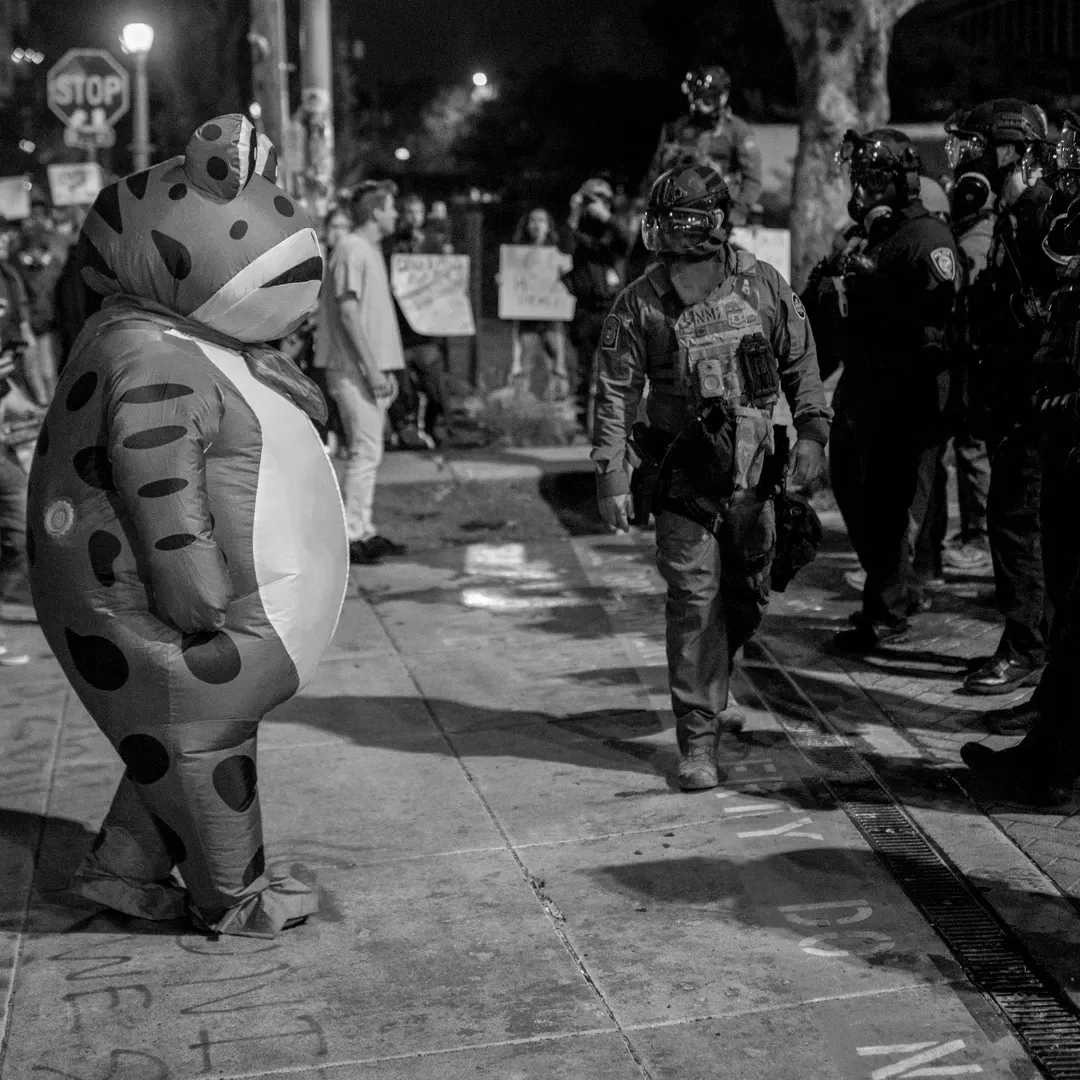
A costume does not trap power into a dilemma. It makes an existing disproportion visible. A heavily armed officer confronting a cartoon animal needs no caption. The image speaks for itself. Where the absurd object forces a reaction, the costume reframes the one already happening: turning repression into spectacle. In a media environment where the unusual travels faster than the serious, that image generates global coverage with minimal resources.
EXAMPLES
Portland, 2025. Protester Seth Todd showed up to an anti-ICE demonstration in an inflatable frog costume. Federal agents pepper-sprayed him, targeting the suit's air valve. The video went viral within hours. "Operation Inflation" followed: costumes distributed freely across Portland to counter the narrative branding demonstrators as violent radicals, and to make government force look more like farce.
Poland, 1982-1988. The Orange Alternative organised happenings in absurd costumes against communist rule. Authorities arrested Santa Clauses. They detained anyone wearing orange. Each arrest made the regime look more ridiculous than the last. On 1 June 1988, 10,000 people marched in Wrocław wearing orange dwarf hats in what became known as the Revolution of Dwarfs. The costume had become a mass political act.
POLITICAL EFFECTS
In Portland, the images of riot police targeting an inflatable frog made it impossible for the administration to brand protesters as violent radicals. The contrast needed no commentary. In Poland, each absurd arrest generated more media attention than any conventional demonstration could have. In both cases, the costume shifted the terms of the confrontation: away from a clash of force, toward a contest of images. And in that contest, power rarely wins.
Critical assessment
Strengths
- 01 Reveals repression: heavily armed officers confronting cartoon animals need no caption.
- 02 Federating power: 10,000 people marched in dwarf hats in Wrocław in 1988.
- 03 Lowers participation barriers, attracting people wary of confrontational forms of protest.
Limits
- 01 Without media coverage, the visual contrast produces a lesser effect.
- 02 Opponents can adapt, reframe the image, or respond with their own staging.
Support Fondemos
Every donation helps us continue supporting democracy's defenders.