TRAPPING POWER WITH AN OBJECT
An object placed in the right spot can do what no speech can: force power to reveal itself. The absurd object tactic consists of introducing a deliberately incongruous element into public space, compelling authority to react. Whatever it does, it loses: repress an inanimate object and look ridiculous, ignore it and let dissent take hold freely. Power finds itself trapped not by force, but by its own logic of control applied to the absurd. This mechanism, which theorists of non-violent resistance call a dilemma action, is all the more formidable for requiring no crowd, no confrontation, no budget.
WHY IT WORKS
Authoritarian regimes operate through intimidation and legitimacy. The absurd object attacks both simultaneously. It exposes the arbitrariness of repression by making it visually grotesque, and it erodes the regime's legitimacy by forcing it to justify the unjustifiable. If it represses, it validates the mockery. If it ignores, it lets the mockery grow. In a media environment where the unusual travels faster than the serious, this dynamic is amplified: an absurd image generates global coverage with minimal resources. The object thus becomes a lever accessible to anyone, capable of shifting the symbolic balance of power without resorting to violence.
EXAMPLES - FROM BELGRADE TO BARNAUL
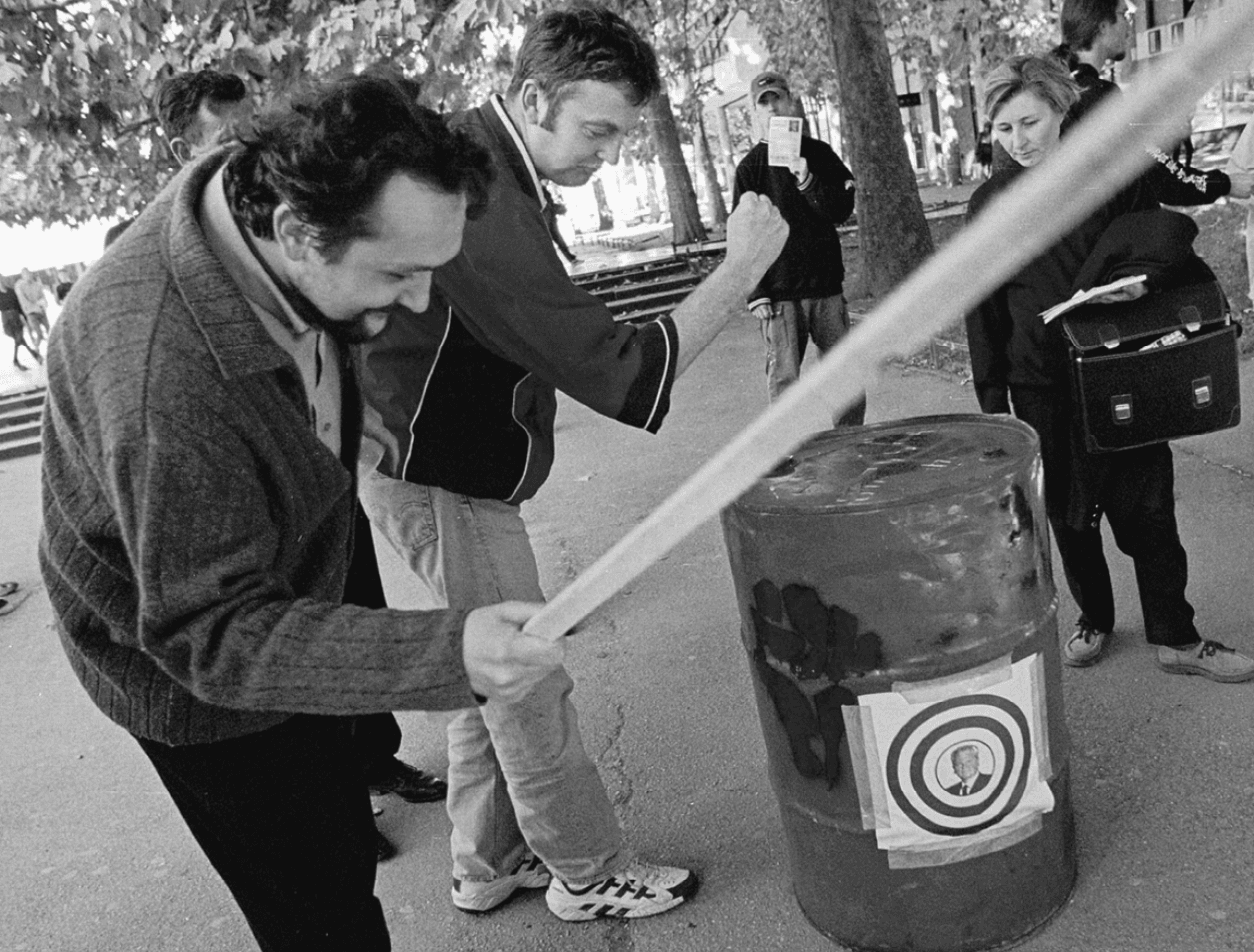
Belgrade, 2000. Student movement Otpor! placed a barrel bearing Milosevic's face in a public square, with a baseball bat alongside it. Passers-by could take turns hitting it. When police arrived, they faced an impossible choice: leave the barrel and let defiance take hold, or take it away and look ridiculous for "arresting" a piece of wood. They chose the latter. Otpor! photographed the scene and distributed it through opposition media: the regime became the laughing stock of its own streets, its aura of untouchability durably undermined.
Barnaul, Russia, 2012. Activists installed dozens of children's toys, teddy bears and figurines, holding signs demanding free elections and denouncing corruption. The authorities declared the gathering illegal. Forced to justify their decision, they publicly stated that the toys were not "Russian citizens" and therefore could not protest. The official response became the joke itself: it circulated through international media, giving global publicity to a local gathering of a few dozen people.
POLITICAL EFFECTS
In both cases, power itself produced the evidence of its own absurdity. In Belgrade, the seizure of the barrel was photographed and widely distributed, turning an act of repression into an admission of weakness. The image contributed to eroding Milosevic's aura of untouchability at a key moment in the mobilisation against his regime. In Barnaul, the official statement about the toys made the rounds of international media, giving unprecedented visibility to an action carried out with next to nothing. In both cases, the result is the same: the regime reveals its fragility not under the pressure of force, but under that of ridicule. And that revelation, once documented and shared, cannot be undone.
Critical assessment
Strengths
- 01 A single object is enough to set the trap.
- 02 Any response from power amplifies the message rather than ending it.
- 03 One local image can become a global media event.
Limits
- 01 Viral images can overshadow the concrete political demands.
Support Fondemos
Every donation helps us continue supporting democracy's defenders.