
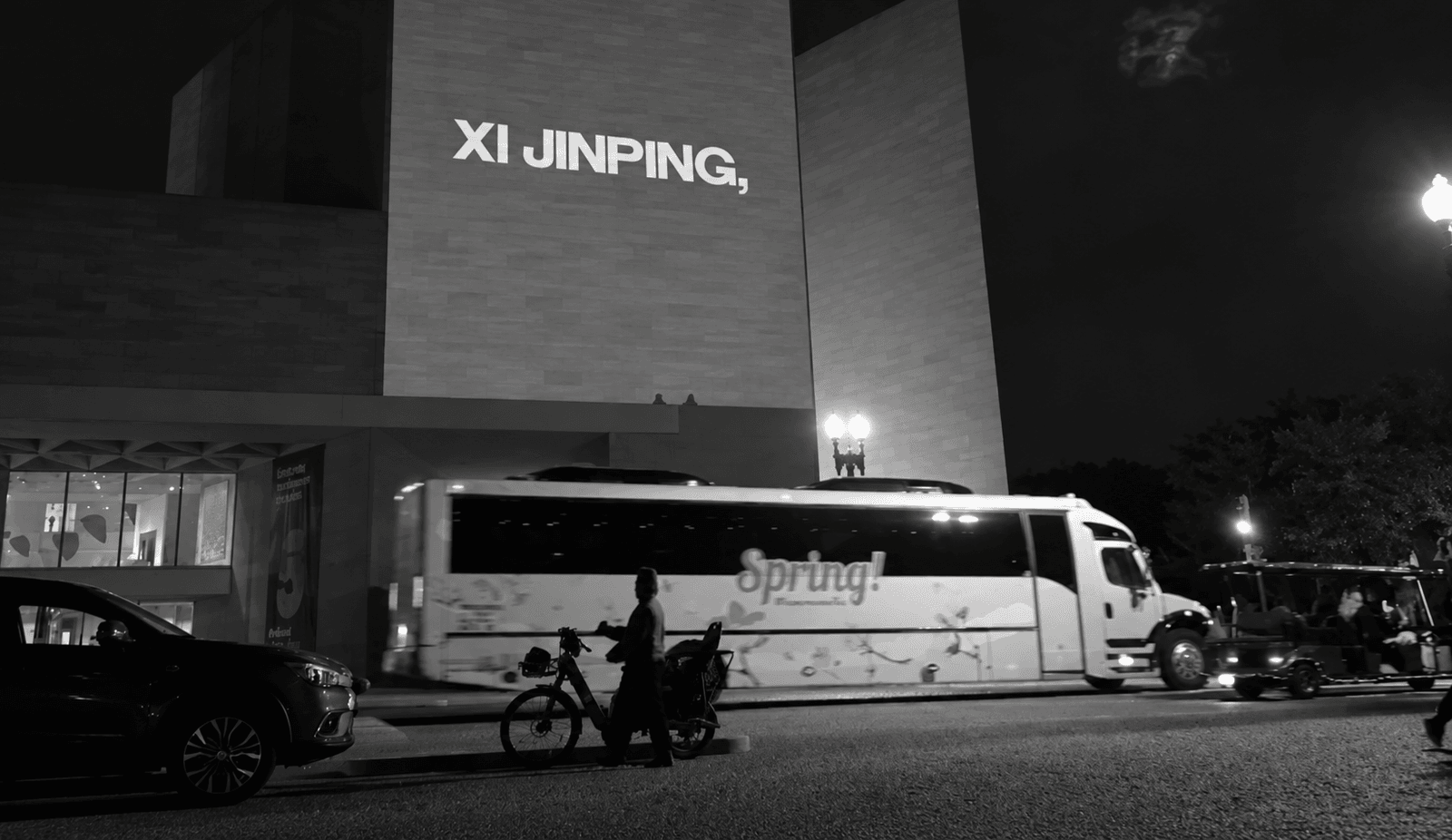
“XI JINPING. RELEASE THEM.”
On 23 September 2026, Xi Jinping arrives in Washington for his first state visit since 2015. That evening, the Human Rights Foundation projects his name in white letters against a red background onto the façade of the National Gallery of Art, followed by portraits of eight prisoners of conscience. Among them are Joshua Wong, a prominent figure in Hong Kong's pro-democracy movement, and Ilham Tohti, a Uyghur economist sentenced to life imprisonment exactly twelve years earlier, to the day.
The action then uses the visibility of the presidential visit to confront the regime's carefully cultivated diplomatic image with the faces of its political prisoners. Trucks displaying messages calling for their release also circulate through Washington. On 30 September, Donald Trump states that he raised the issue of political prisoners with Xi Jinping, without specifying which individuals were discussed.
THE ADVERSARY'S FAÇADE
An authoritarian regime controls public spaces within its borders and carefully manages its image abroad, particularly during official visits. The technique consists of projecting images or text onto the façade of a public building using a projector, without physically altering or damaging it. The operation uses this device to turn the very symbols of the regime's power against it.
The authorities are then faced with a choice: leave the message visible or intervene, potentially drawing even more attention to the protest. Within the country itself, the tactic can also be used covertly: in Chongqing, in August 2025, an activist remotely activated an anti-government projection after leaving China. Once filmed and shared online, the action can continue to circulate long after it has been shut down.
A SHORT DISPLAY, A LASTING REACH
Projections can be quickly shut down by police or security personnel, but their reach is not measured by how long they remain visible. It depends above all on whether they are filmed and shared, particularly through media outlets and activist networks. Footage of a projection carried out by a single individual can thus reach a far wider audience than the passers-by who witness it.
When captured on camera, the authorities' intervention can itself help amplify the message.
The tactic can keep demands in the public eye at a time when a regime is seeking to strengthen its legitimacy or improve its international image.
Critical assessment
Strengths
- 01 Reputational cost: shutting it down draws more attention.
- 02 Minimal mobilisation needed: a small team, or one person, suffices.
- 03 Naming the victims gives them a face and an identity.
Limits
- 01 Risk of reprisals for activists and their relatives.
- 02 Reliance on amplification: without it, reach stays limited.
- 03 Political impact is hard to measure, especially on releases.
Support Fondemos
Every donation helps us continue supporting democracy's defenders.