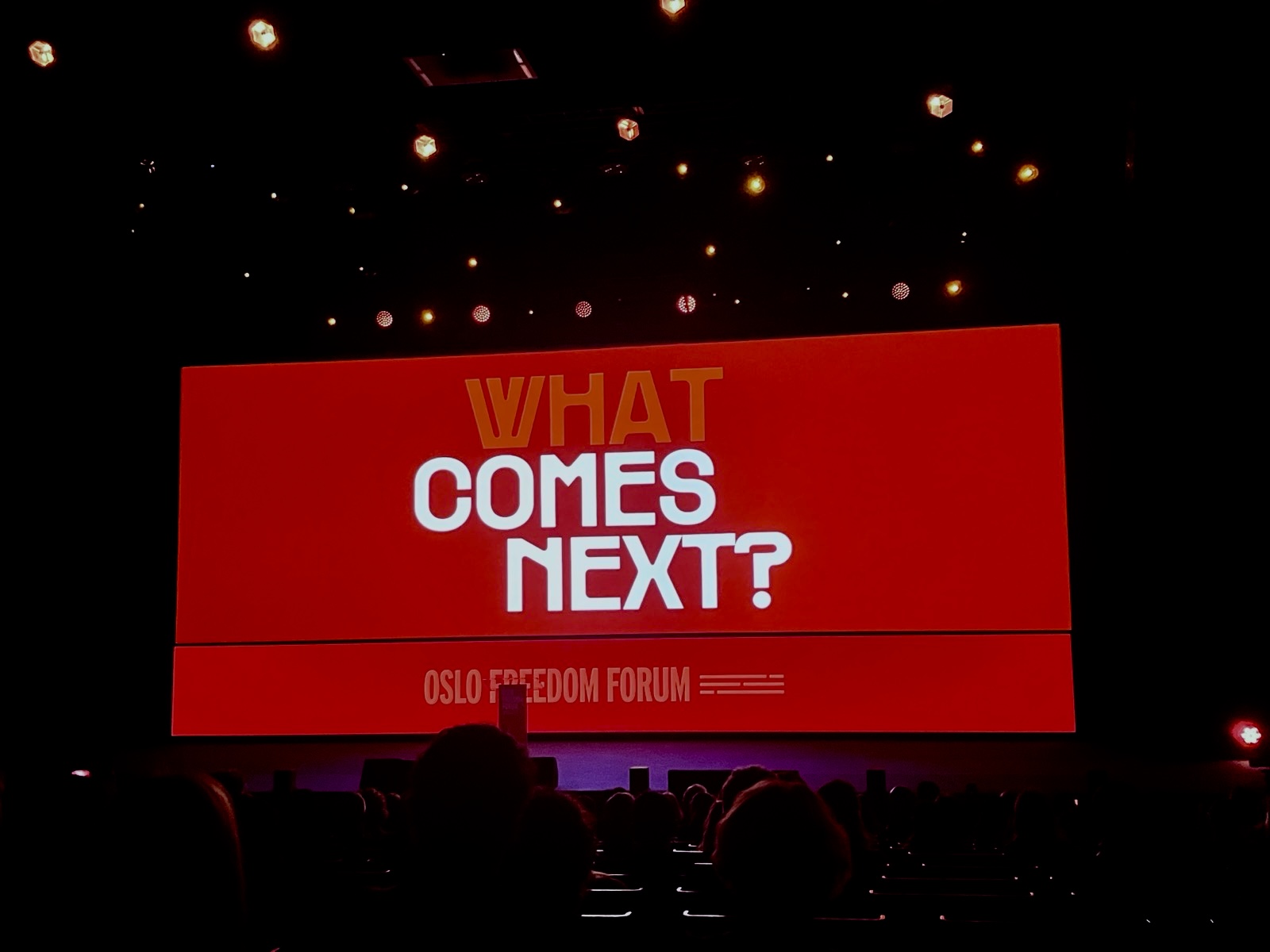
One week after the close of the Oslo Freedom Forum 2026, it is time to reflect on what this event reveals, as much through what it showcases as through what it leaves unresolved, about the state of the global movement for freedom and democracy.
This edition confirmed what makes the forum singularly valuable: a remarkable geographical diversity, spanning Asian, Latin American, African and European dynamics. Few spaces in the world make it possible to connect, within the space of a few days, so many civil society leaders from such varied contexts. This is a genuine contribution to building an international network of freedom fighters.
Fondemos draws from it, however, a few observations.
The first concerns the dominant political framing. Several speeches presented American engagement as the central lever for responding to democratic crises. This reading, whilst legitimate in certain contexts, deserves to be nuanced: a global democratic movement cannot rest on a single geopolitical grammar, just as a democracy, by definition, cannot rest on a single actor.
The second touches on ideological direction. The OFF audience has always been committed to fundamental political freedoms. Yet Pavel Durov’s address appeared to nudge this liberal tradition towards a libertarian register, a distinction that is not without consequence for the collective framework of thought.
The third, finally, concerns thematic priorities. The emphasis placed on AI and cryptocurrency as tools of democratic empowerment raises a fundamental question: in contexts where the internet is cut off, where taking to the streets is already a high-risk act, where the priority is to communicate and stay safe, are these tools truly the most urgent? Does such an emphasis not risk lapsing into techno-solutionism?
Despite our collective efforts, democracy continues to recede across the world. The Oslo Freedom Forum remains a rare and precious space. It is precisely because it matters that the question deserves to be asked: are the means we collectively prioritise sufficiently in service of the objectives we share?