
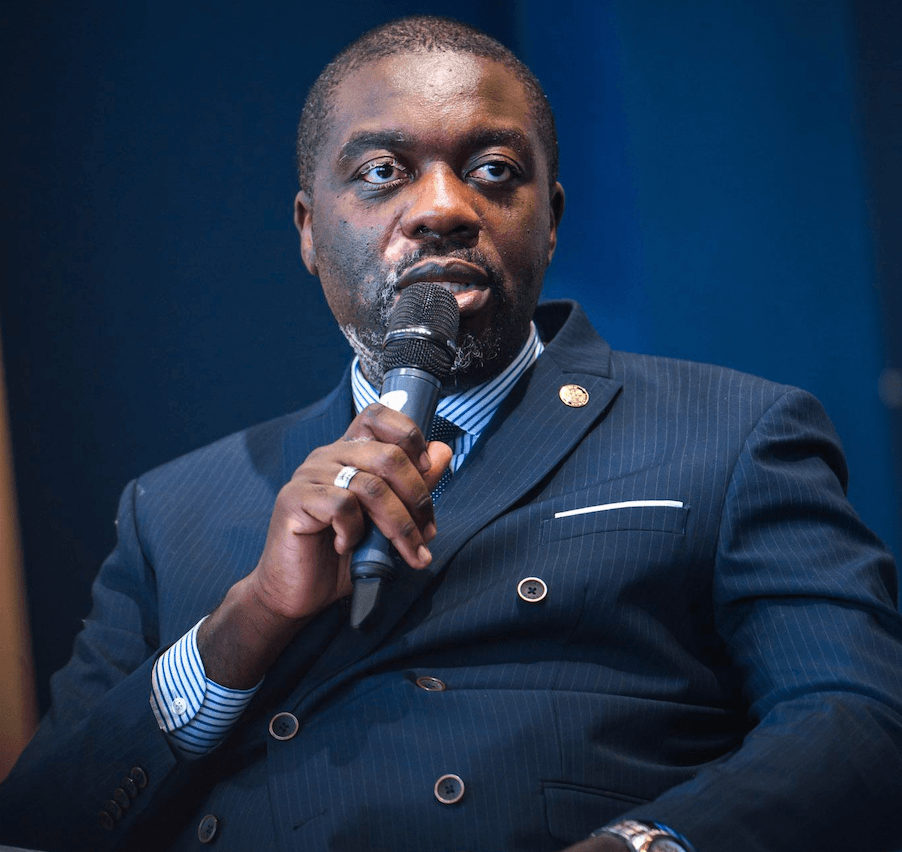
Key points
- 01 A former banker in the DRC, he exposed irregularities in Independent National Electoral Commission bank accounts under the Kabila regime, a stand that forced him into exile.
- 02 He now chairs Collectif Restitution Afrique, working to trace and return assets and cultural heritage illicitly taken from African states.
- 03 For him, defending democracy and the rule of law is inseparable from the fight against corruption.
Our work is based in particular on combating corruption, the misappropriation of public resources and illicit financial flows, all of which contribute to depriving African States and populations of resources essential to their development. In this context, we are particularly interested in mechanisms for identifying and tracing funds and assets illicitly removed from their rightful ownership and, where the relevant legal requirements are met, facilitating their recovery and restitution to the countries concerned. This approach also forms part of a broader reflection on the concept of “reverse ill-gotten gains”, understood as the issue of wealth, capital or assets originating from the African continent that may have been illicitly transferred, misappropriated or concealed abroad. Our aim is to contribute to the debate on the legal, institutional and international mechanisms capable of facilitating their identification and restitution, while fully respecting the rights of the defence, the presumption of innocence, judicial decisions, and applicable national and international law. Alongside this economic and financial dimension, Collectif Restitution Afrique also works on the restitution of cultural objects, works of art and elements of African heritage currently located outside their territories or communities of origin. This work seeks to foster constructive dialogue between African States, holding States, cultural institutions, museums, researchers and other relevant stakeholders in order to examine, on a case-by-case basis, the historical, ethical and legal circumstances in which these objects left the continent. Our approach is not intended to arbitrarily challenge property rights or to promote restitution outside the procedures established by law. On the contrary, it seeks to ensure that restitution takes place in strict compliance with the rule of law, national legislation, international conventions and the relevant judicial or administrative procedures. Through these various commitments, our ambition is to contribute to an African and international approach to restitution based on justice, transparency, cooperation between States and legal certainty. Whether the issue concerns financial resources illicitly removed from African economies or cultural heritage whose circumstances of acquisition or transfer warrant examination, we uphold the principle that every restitution process must be properly documented, legally grounded and conducted with full respect for the competent institutions. Collectif Restitution Afrique therefore seeks to contribute to the development of sustainable mechanisms for combating corruption and illicit financial flows, facilitating asset recovery where legally justified, and supporting the restitution of African cultural heritage, while making respect for the law and international cooperation the foundations of its work.
In my capacity as President of Collectif Restitution Afrique, I am one of the association's principal officers and play a central role in determining its direction, organising its work and implementing its activities. In this capacity, I contribute to defining the Collectif's main strategic priorities, coordinating its various activities and missions, and mobilising and bringing together the human, institutional, technical and material resources required to achieve its objectives. My role also includes fostering cooperation between the various stakeholders and partners who may contribute to the Collectif's activities, representing the association before its institutional counterparts, and ensuring consistency across the initiatives undertaken in its different areas of work. Finally, this responsibility involves bringing together expertise and commitment around the values and objectives of Collectif Restitution Afrique in order to strengthen its capacity for action and effectively fulfil its missions, particularly in the fields of combating corruption and illicit financial flows, asset restitution and the restitution of African cultural heritage, in strict compliance with the law and applicable procedures.
In carrying out our mission, we make use of all lawful means of communication, information, awareness-raising and action that may contribute to achieving our objectives. Our approach is based in particular on raising public awareness, engaging in dialogue with relevant institutions and stakeholders, mobilising civil society, cooperating with our partners and, where necessary and legally justified, making use of the administrative and judicial procedures provided for under applicable law. All our initiatives are conducted in strict compliance with the rule of law, applicable laws and regulations, and relevant national and international procedures. Our objective is to advance the cause of restitution through peaceful, responsible and legally regulated means, combining dialogue, awareness-raising and advocacy with, where circumstances warrant it, the exercise of available legal remedies.
« Defending democracy does not mean seeking uniformity of opinion: it means preserving a common framework within which disagreements can be expressed freely, confronted and resolved through institutions rather than coercion »
My journey as a whistleblower and defender of democratic principles began with my professional experience in the banking sector in the Democratic Republic of the Congo. In the course of my work as a banker, I encountered financial transactions and practices that I considered sufficiently serious to warrant bringing them to the attention of the public and the competent authorities. My disclosures concerned, in particular, the management of bank accounts linked to the Independent National Electoral Commission (CENI) and, more broadly, financial practices that I believed to be associated with the system of power in place under President Joseph Kabila. Through this action, I notably denounced what I regarded as manipulation and irregularities affecting certain CENI bank accounts, against a particularly sensitive political backdrop marked by controversy surrounding the electoral timetable and the organisation of elections intended to open a new democratic chapter and, ultimately, lead to President Joseph Kabila's departure from power. Taking this position marked a decisive turning point in my personal and professional life. By choosing to make public information that I believed to be in the public interest, I embarked on a whistleblowing process grounded in the defence of financial transparency, institutional accountability and respect for democratic principles. Following these disclosures, I faced what I experienced as pressure, intimidation and repressive measures in an environment that gradually became incompatible with my safety and with the normal continuation of my activities. This situation ultimately forced me to leave the Democratic Republic of the Congo and live in exile. This experience profoundly shaped the course of my subsequent engagement. It strengthened my conviction that the fight against corruption, the misappropriation of public resources and illicit financial flows is inseparable from the defence of the rule of law and democracy. My experience as a whistleblower thus gradually developed into a broader commitment to transparency, economic justice, the restitution of assets illicitly taken from African peoples, and the protection of the continent's heritage.
Democracy is a fundamental value and an essential pillar of the protection and strengthening of both public and individual freedoms. It requires constant commitment in order to safeguard democratic achievements and contribute to building a world that is fairer, freer and more respectful of everyone's rights. This commitment is particularly important in a context marked by the growing influence of sovereigntist, populist and, in some cases, extremist movements, which raise questions about democratic balances and about our societies' ability to preserve pluralism, tolerance and the rule of law.
Tomorrow's democratic activists may no longer define themselves exclusively through membership of a political party, political family or traditional ideology. Instead, they may increasingly be united by a shared determination to preserve democracy, fundamental freedoms, pluralism and the rule of law in the face of authoritarian tendencies and the radicalisation of public debate. In a world experiencing the rise of populism, nationalism and certain forms of sovereigntism, the defence of democracy could therefore become a new space for collective action. It could bring together citizens from different backgrounds around a common foundation: respect for individual and collective freedoms, human dignity, tolerance, dialogue and the rejection of political violence. The democratic activist of tomorrow would therefore be defined less by their position on the traditional left-right spectrum than by their commitment to democratic institutions and to ensuring that differing opinions can coexist peacefully. The challenge would thus be to foster a new democratic consciousness capable of transcending traditional divides without erasing political differences. Defending democracy does not mean seeking uniformity of opinion; it means preserving a common framework within which disagreements can be expressed freely, confronted openly and resolved through institutions rather than coercion. Democracy would then become not only a system of government, but also a permanent responsibility: the responsibility to protect the common space that allows every citizen to be free, to participate in public life and to contribute to shaping the future.
INSPIRING STANDPOINTS BY JEAN-JACQUES LUMUMBA / Interviewed by Fondemos.
Support Fondemos
Every donation helps us continue supporting democracy's defenders.